
In the summer of 2022, the Hawaiʻi Department of Health asked medical cannabis patients whom they rely on for medical information about cannabis. About two thirds named a medical provider. More than half, 56 percent, named dispensary workers. That second number has traveled. It is easy to remember and easy to bend. It deserves a careful read, because it touches how patients learn about something they take for their health.
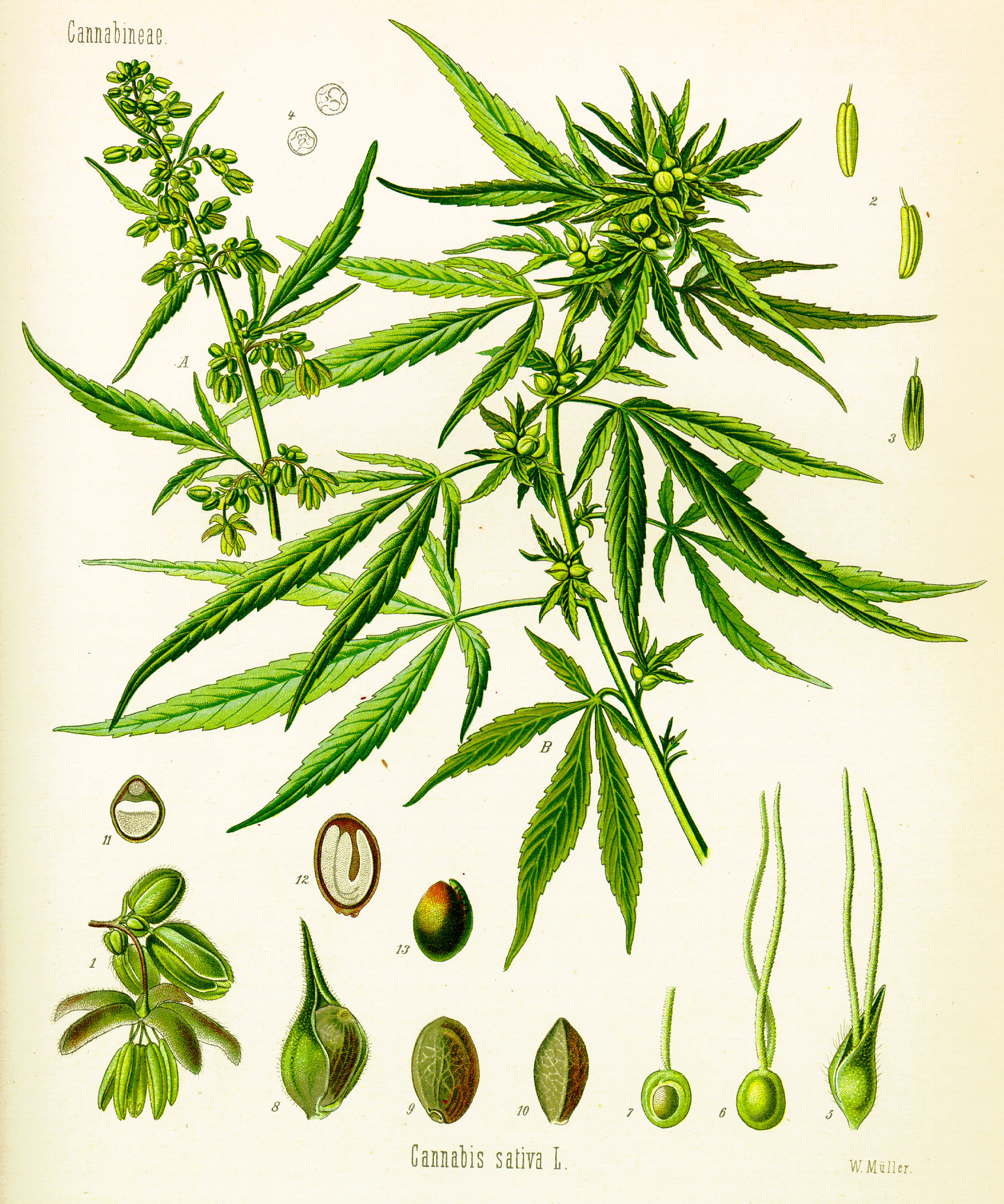
Cannabis sativa L., the plant patients are asking about, in a botanical plate from Köhler's Medizinal-Pflanzen, 1887. Plate: Köhler's Medizinal-Pflanzen (1887)/Wikimedia Commons, public domain
This piece goes through what the survey asked, what it could and could not measure, what Hawaiʻi’s rules and laws say about the people on each side of the counter, and which statements in the state’s own materials rest on a source. Every document cited below was opened and read for this piece, and the sources are linked at the point of each claim.
What the survey asked
The survey had a legislative reason. Act 169 of 2021 set up a task force to study legal adult use of cannabis and what it would mean for medical patients. At the task force’s request, the Department of Health’s Office of Medical Cannabis Control and Regulation (OMCCR) ran a quick online survey from July 28 to August 2, 2022. OMCCR emailed the link to registered patients, caregivers and certifying clinicians, using the email address each had on file with the program. [1]
In all, 3,302 patients or caregivers and 33 clinicians answered. The report says that is about 10 percent of the 34,200 registered patients and 9 percent of the 385 certified clinicians. Patients could stop after the first section. Of the 3,302, a total of 2,526 went on to the second section, where the information question sat. [1]
That question, number 14, read: “Who do you rely on for medical information about cannabis? (Check all that apply).” It offered six choices: the doctor or nurse who helped the patient get a 329 card, a primary care doctor, nurse or other health care professional, health care professional websites and conferences, the dispensary workers, the Hawaii Department of Health, and “other.” [1]
Figure 10 of the report shows how 2,217 patients answered: [1]
Medical provider (primary care, or the doctor or nurse who helped with the 329 card): 66.2 percent
Dispensary employees: 55.9 percent
Health care professional websites and conferences: 31.5 percent
Hawaii Department of Health: 15.6 percent
The report’s text rounds the second figure to 56 percent and calls dispensary workers “the next most relied upon source.” In the written comments, some patients named themselves (8 percent) or the internet (4 percent). [1]
Reading the 56 percent carefully
Five details change how the number should be read.
Patients could pick more than one answer. Because the question said “check all that apply,” the 66.2 percent and the 55.9 percent are overlapping groups. The two shares add up to 122.1 percent. So at least 22.1 percent of the patients who answered, about 1 in 5, must have named both a medical provider and dispensary workers. The report’s own conclusion says patients “rely mostly on their certifying medical cannabis providers for information.” The survey does not show dispensary staff replacing clinicians. It shows many patients using both. [1]
The provider bar joins two answers. The questionnaire listed the certifying clinician and the primary care clinician as separate choices. Figure 10 merges them into one “Medical Provider” bar. The report does not say how many patients named their certifying clinician alone. So the 66.2 percent cannot tell us how many rely on the person who signed their certification in particular. [1]
It counts reliance, and nothing about quality. The survey asked whom patients rely on. It did not measure what they were told, whether the advice was sound, whether they acted on it, or what happened next. The topic was “medical information about cannabis,” which is narrower than health education in general. [1]
It reflects the patients who chose to answer. The report says plainly that the survey used “convenience sampling with opt-in participation, so the results do not represent the medical use program patient and provider populations.” The invitation went by email, so only people with internet access that week could take part. No demographic data was collected. The report itself recommends future surveys with representative sampling. [1]
The denominator is small next to the program. The 2,217 patients who answered question 14 are about 6.5 percent of the 34,199 patients registered on June 30, 2022. That makes the 56 percent a fair snapshot of the people who answered. It is a weak basis for a precise statewide share. [1]
How the number has traveled
Numbers from this survey now show up in other places. Two examples show why the wording matters.
A May 2025 slide deck by a guest speaker, posted on the Department of Health’s website, says “57% Medical Cannabis Patients rely on dispensary workers for health education.” [9] The report’s figure is 55.9, which rounds to 56. The survey asked about “medical information about cannabis,” and the phrase “health education” does not appear in the question. The only 57.0 percent values in the report sit in the clinician table, where 33 clinicians answered. [1]
Lawmakers cite the survey too. A 2025 House bill on caregivers quotes its finding that “fifty-five per cent of patients indicated that they obtained their cannabis exclusively from a licensed medical cannabis dispensary.” [8] That one matches the report, which says 55 percent of patients bought only from dispensaries and 86 percent bought at least some products there. [1]
If you cite the information question, the accurate version is this: 56 percent (55.9 percent) of the 2,217 patients who answered an opt-in 2022 state survey said they rely on dispensary workers for medical information about cannabis, and patients could choose more than one source.
Who is behind the counter
If more than half of the patients who answered rely on dispensary staff, the next question is what those staff are required to know.
Hawaiʻi does have a training rule. Under section 11-850-34 of the Hawaii Administrative Rules, each licensed dispensary must keep written policies on hiring and training. It must train every employee when hired and once a year after that. The rule lists five topics the training must include, “but not be limited to”: health, safety and sanitation standards; security; prohibitions and enforcement; confidentiality; and the other rules that apply to that person’s job. Staff must be at least 21. [2]
The rule sets no minimum hours. Its list does not name cannabis effects, medicine interactions or how to answer a patient’s health question. A dispensary may teach more than the list, and some likely do. But no public report shows what Hawaiʻi’s dispensaries actually teach, how many staff have a medical or science background, or what staff tell patients. The Department of Health’s most recent annual report to the Legislature counts licensees and locations. It does not count staff. As of December 23, 2025, it lists eight licensees with 24 retail locations and 10 production centers statewide. [7]
The state’s rules for choosing licensees do mention patient education. One of the merit criteria for license applicants is the capacity to meet patients’ needs, including “educating patients on how cannabis can be used to assist patients with debilitating medical conditions.” [2]
Other states show what a more specific standard can look like. Washington lets a certified “medical cannabis consultant” advise patients in stores that hold a medical endorsement. Its rules require at least 20 hours of approved training, including 5 hours on choosing products suited to a patient’s condition, contraindications and methods of use, 2 hours on short and long term effects, and 2 hours on warning signs of overuse and addiction, with an exam at the end. [11] The same rules say a consultant may explain a product’s risks and benefits but may not diagnose or treat a condition, and may not advise a patient against treatment other than cannabis. [12] This comparison describes another state’s rules. It does not judge Hawaiʻi’s.
The closest study of what dispensary staff do comes from the mainland. In a 2016 survey of 55 dispensary staff, mostly in Colorado, California and Arizona and recruited by email, phone and social media, 55 percent reported some formal training for their job and 20 percent reported medical or scientific training. Ninety-four percent said they give patients specific cannabis advice. The authors found that many staff made recommendations “consistent with current evidence,” while some recommended cannabis that had not been shown to help a patient’s condition, or that could make it worse. They called for consistent, evidence-based training. [10] That study is small and self-selected, and it is not about Hawaiʻi. It shows that advising patients is a normal part of the job elsewhere. It cannot tell us what happens on Oʻahu.
None of this makes dispensary staff the problem. They are the people patients see most often. A December 2025 economic report commissioned by OMCCR estimates that licensed dispensaries capture about 86 to 87 percent of what registered patients spend on cannabis. [22] The open question is what support counter staff have, and how their advice connects to a clinician’s.
What the clinicians in the survey said
The 2022 survey also asked the 33 clinicians who answered whether they were concerned that, after legalization, “patients will be getting misinformation from the dispensaries and media.” Eighteen percent somewhat agreed and 18 percent strongly agreed. Fifty-seven percent did not agree. [1] With 33 answers, that is a glimpse and not a measure. It does show that clinicians were split on the question.
Who is on the clinic side
OMCCR’s data report for August 2026 lists 29,315 patients with a valid in-state registration and 2,342 caregivers. It says 248 physicians and advanced practice registered nurses have certified one or more patients who are currently registered. [6] Divide the two and the average is about 118 registered patients for each of those clinicians. An average hides the spread, since some clinicians certify many patients and others very few. The 2022 report counted something different, the 385 clinicians registered with the program, so the two figures should not be read as a trend. [1] [6]
The program has been shrinking. In Act 241 of 2025, the Legislature found that registered patients peaked at 35,444 in August 2021 and fell to 30,035 by November 2024. [3]

The Hawaiʻi State Capitol in 1973. The Legislature that meets here passed Act 241 in 2025, which changed who can certify medical cannabis patients and what they must explain. Photo: Charles O'Rear/U.S. National Archives, public domain
Who can certify, and for what. A patient can now qualify with a condition outside the list of debilitating conditions, if the patient’s “primary treating medical provider” certifies that the likely benefits outweigh the health risks. The act defines that provider as a Hawaiʻi physician or APRN who is “primarily responsible for the treatment and ongoing care” of the patient. Patients in hospice also qualify. [3] The Department of Health’s guidance spells out that the primary treating provider can be a primary care clinician or a specialist treating the specific condition. [5]
A duty to explain. Medical use is allowed only if the certifying clinician “has explained the potential risks and benefits” to the patient and documented in the medical record that the patient understands them. [3] In other words, the law already names the certifying clinician as a source of information.
Telehealth. The clinician and patient relationship can be set up by telehealth, with no in-person visit required first. [3]
A fee cap. A certifying clinician’s fee may not exceed three times the fee the Department of Health charges for a registration certificate. [3]
Records inspection. The department may inspect the medical records of a certifying clinician, and may suspend or revoke the ability to certify if the clinician refuses or the records do not comply. [3]
OMCCR’s August 2025 newsletter summarized the act a little differently. It said the act covers “any condition being actively treated by a medical provider,” and that inspections check for patient safety steps, “including taking a complete medical history, evaluating potential drug interactions with cannabis.” [4] The act’s text ties the new pathway to the patient’s primary treating provider, and the inspection section does not use the words “drug interactions.” [3] The newsletter is a plain-language summary. For the law itself, read the act.
Clinicians elsewhere report a knowledge gap. In a Washington State survey published in 2020, run from February to April 2018, 310 of the 1,440 clinicians invited were eligible respondents, a 24 percent response rate. Among them, 58 percent said they did not feel they had the knowledge and skills to provide authorizations. [13] A 2025 consensus statement in JAMA Network Open, built by a panel of 23 experts, starts from the finding that “most health care practitioners and trainees report feeling unprepared to counsel patients.” It sets out six core competencies for medical students, from the endocannabinoid system to the risks of use and basic clinical management. [14] OMCCR links that statement on its own clinician resources page. [18] Those studies cover different groups and different places. They point the same way.
The course with four descriptions
OMCCR does offer clinicians a course. Over the past year its public materials have described that course in four ways. Read in order, they mostly fit together. One question is still open.
August 2025. The newsletter announced “FREE” continuing medical education and said “the first 200 professionals to enroll in the program are FREE.” [4] The flyer linked at the time described a 5-credit bundle, free for the first 200 enrollees, after which “the activities will remain available for $189.” [16]
February 2026. A newer flyer keeps the heading “How to Access Your Free Hawaiʻi Medical Cannabis Course Bundle.” Its body says Hawaiʻi clinicians get a 20 percent discount and can enroll for $151. [17] That is 20 percent off $189.
OMCCR’s clinician resources page describes the course as “4 CME/CE credits composed of 2 courses.” [18]
The course provider’s page lists 6 credits across 3 courses, including a new 2-credit course on cannabis use disorder and cannabinoid hyperemesis syndrome, at $249. It also notes that “cannabis-related CME/CE is not required by Hawaii law.” [19]
So the free seats came first, then a discount, then a larger bundle at a higher list price. What the public pages do not say is whether the 20 percent discount still applies to the $249 bundle, or how many of the 200 free seats were used. A single current page with the credits and the price would settle it for clinicians.
The “over 13 percent” line
The same August 2025 newsletter makes a second claim in its education section: “Over 13% of the state’s population currently uses cannabis.” No reference is attached to that sentence. [4]
The closest federal source is the National Survey on Drug Use and Health (NSDUH), whose state tables estimate marijuana use in the past month among people 12 and older. For Hawaiʻi, the 2022 to 2023 estimate was 15.14 percent, with a 95 percent confidence interval of 12.76 to 17.86. The 2023 to 2024 estimate was 11.67 percent, with an interval of 9.68 to 14.00. [20] [21] In round terms, that is between about 1 in 7 and 1 in 9 people 12 and older, depending on the years.
Three cautions apply. First, “currently uses” has to mean past-month use to match these tables, and the tables count marijuana vaping in that figure. Second, they cover people 12 and older, not the whole population. Third, the two estimates share the year 2023 and their ranges overlap, so the drop from 15.14 to 11.67 should not be read as a trend. [20] [21] “Over 13 percent” falls inside both ranges. It is plausible. It would be easier to trust with a citation and the words “past month” attached.
What would help
These suggestions build on work OMCCR already does through its newsletter, its education pages and its course.
Ask patients where they get their information. The 2022 survey asked it once, in a short online form. A clinician can ask it at every visit. The answer shows what a patient has already heard, and the conversation can start there. A recent CDC report on cannabis hyperemesis syndrome makes a similar point from the emergency room. It notes that “clinicians might not routinely assess or document patients’ cannabis use,” and suggests routinely asking about frequency, duration, product type and route of use. [15]
Treat the counter and the clinic as one system. At least 1 in 5 respondents named both a provider and dispensary workers. Staff and clinicians could point patients to the same plain reference, so a dispensary visit and a clinic visit lead to the same evidence.
Publish what counter staff learn. Hawaiʻi’s rule requires yearly training but does not name clinical topics. [2] A public summary of what that training covers would let patients and clinicians know what to expect at the counter.
Repeat the survey with a representative sample. The 2022 report itself recommends it. [1] The state’s December 2025 economic study surveyed medical patients about spending but did not ask where they get information. [22] A Hawaiʻi-wide estimate would settle questions that now rest on one opt-in survey.
Source the numbers that circulate. A reference for the “13 percent” line, and one page that states the course’s credits and price, would remove two avoidable questions.
For patients. Bring what you hear at the counter to your certifying clinician, and tell both about every product and medicine you use. OMCCR’s August 2025 newsletter gives similar advice, such as consulting a provider during pregnancy or breastfeeding, and asking a provider whether inhaling is right for someone with a weakened immune system. [4]
What the sources do not show
How many patients rely on their certifying clinician in particular. Figure 10 merges the two clinician answers. [1]
What patients did with the information. The survey measured reliance, not outcomes. [1]
A representative picture. The survey was opt-in and collected no demographics. [1]
Where the 13 percent line came from. The newsletter gives no source. [4]
A note on what this is
Educational information, not medical advice and not legal advice. If you are a patient, your certifying clinician and your pharmacist are the right people for questions about your own care.
RN Collins is a storytelling strategist, content and experiential producer, resident neuroscientist and design technologist.
Sources
Hawaii State Department of Health, Office of Medical Cannabis Control and Regulation, "Rapid survey among Hawai'i medical cannabis patients and providers on the potential effects of legalization of adult use," August 22, 2022 (methods p. 6; limitations p. 7; Figure 10 p. 20; conclusions p. 23; question 14 p. 27). https://health.hawaii.gov/medicalcannabis/files/2022/08/Medical-Cannabis-Patient-and-Provider-Survey-July-2022.pdf
Hawaii State Department of Health, "Amendment and Compilation of Chapter 11-850 (Interim Rules), Hawaii Administrative Rules, Medical Cannabis Dispensaries," compiled November 17, 2025 (sections 11-850-20 and 11-850-34). https://health.hawaii.gov/medicalcannabis/files/2025/12/Chapter11-850-HAR-Nov17-2025.pdf
Legislature of the State of Hawaii, "Act 241, H.B. No. 302, A Bill for an Act Relating to Cannabis," Session Laws of Hawaii 2025, approved June 27, 2025. https://data.capitol.hawaii.gov/sessions/sessionlaws/Years/SLH2025/SLH2025_Act241.pdf
Hawaii State Department of Health, Office of Medical Cannabis Control and Regulation, "Hawai'i Medical Cannabis Newsletter," August 2025. https://health.hawaii.gov/medicalcannabisregistry/files/2025/08/August-2025-Newsletter.pdf
Hawaii State Department of Health, Office of Medical Cannabis Control and Regulation, "Guidance for Hawaiʻi Medical Providers: Medical Cannabis Certification by Primary Treating Medical Providers," December 2025. https://health.hawaii.gov/medicalcannabisregistry/files/2025/12/Primary-Treating-Medical-Provider-Final.pdf
Hawaii State Department of Health, Medical Cannabis (329) Registry Program, "August 2026 Program Data," data as of August 31, 2026. https://health.hawaii.gov/medicalcannabisregistry/files/2026/09/August-2026-Report_Valid.pdf
Hawaii State Department of Health, Office of Medical Cannabis Control and Regulation, "Annual report to the 2026 Legislature on the medical cannabis dispensary licensing program," submitted January 20, 2026. https://health.hawaii.gov/opppd/files/2026/01/OMCCR_MCDLS-AR-to-2026Leg_sub-20260120.pdf
Hawaii House of Representatives, "H.B. No. 1110, Relating to Medical Cannabis," 2025 session. https://data.capitol.hawaii.gov/sessions/session2025/bills/HB1110_.HTM
Wendy Gibson-Viviani, "Understanding Medical Cannabis," slide deck posted by the Hawaii State Department of Health, May 2025 (slide "Survey says," PDF p. 41). https://health.hawaii.gov/medicalcannabisregistry/files/2025/05/WGV-DOH-Medical-Cannabis-ECS-May-2025.pdf
Haug NA, Kieschnick D, Sottile JE, Babson KA, Vandrey R, Bonn-Miller MO, "Training and Practices of Cannabis Dispensary Staff," Cannabis and Cannabinoid Research 1(1):244 to 251, 2016. https://doi.org/10.1089/can.2016.0024
Washington State Department of Health, "WAC 246-72-110, Training program requirements," Washington Administrative Code. https://app.leg.wa.gov/WAC/default.aspx?cite=246-72-110
Washington State Department of Health, "WAC 246-72-030, Practice parameters," Washington Administrative Code. https://app.leg.wa.gov/WAC/default.aspx?cite=246-72-030
Kaplan L, Klein T, Wilson M, Graves J, "Knowledge, Practices, and Attitudes of Washington State Health Care Professionals Regarding Medical Cannabis," Cannabis and Cannabinoid Research 5(2):172 to 182, 2020. https://doi.org/10.1089/can.2019.0051
Zolotov Y, Mendoza Temple L, Kogan M, et al., "Developing Medical Cannabis Competencies: A Consensus Statement," JAMA Network Open 8(10):e2535049, 2025. https://doi.org/10.1001/jamanetworkopen.2025.35049
Vivolo-Kantor AM, Liu S, Tanz LJ, Mattson CL, Schier J, "Trends in Emergency Department Visits Involving Cannabis Hyperemesis Syndrome Identified Using a New Diagnosis Code, United States, January 2023 to May 2026," MMWR 75(30):391 to 396, 2026. https://doi.org/10.15585/mmwr.mm7530a2
Hawaii State Department of Health, Office of Medical Cannabis Control and Regulation, "Hawai'i Medical Cannabis CME/CE Course Bundle" flyer, August 2025 (archived copy of January 16, 2026; the original link no longer loads). https://web.archive.org/web/20260116163312/https://health.hawaii.gov/medicalcannabisregistry/files/2025/08/Provider-CME-Flyer-DOH-website-1.pdf
Hawaii State Department of Health, Office of Medical Cannabis Control and Regulation, "Hawai'i Medical Cannabis CME/CE Course Bundle" flyer, February 2026. https://health.hawaii.gov/medicalcannabis/files/2026/02/ProviderCMEFlyer.pdf
Hawaii State Department of Health, Cannabis Education and Resources, "Resources for Clinical Practice." https://health.hawaii.gov/cannabisinsights/resources-for-clinical-practice/
The Answer Page, "The Hawaii Medical Cannabis Course Bundle." https://www.theanswerpage.com/product/the-hawaii-medical-cannabis-course-bundle-2/
Substance Abuse and Mental Health Services Administration, "2022 and 2023 NSDUH Model-Based Prevalence Estimates (50 States and the District of Columbia)," Table 3. https://www.samhsa.gov/data/sites/default/files/reports/rpt56185/2023-nsduh-sae-tables-percents/2023-nsduh-sae-tables-percent.pdf
Substance Abuse and Mental Health Services Administration, "2023 to 2024 NSDUH Model-Based Prevalence Estimates (50 States and the District of Columbia)," Table 3, December 2025. https://www.samhsa.gov/data/sites/default/files/reports/rpt56957/2024-nsduh-sae-tables-percent-csvs/2024-nsduh-sae-tables-percent.pdf
Cannabis Public Policy Consulting (Gideon Cunningham), "An Economic Analysis of the Current Medical and Future Adult-Use Cannabis Market in Hawai‘i," prepared for the Hawaii State Department of Health, Office of Medical Cannabis Control and Regulation, December 19, 2025. https://health.hawaii.gov/medicalcannabis/files/2026/01/HawaiiReportDesigned_1.20.pdf
Corrections and additional primary sources: write to me through the Connect page. Substantive corrections will be dated here.
I’m taking on clients for storytelling strategy and content production and operations. DMs are open on LinkedIn.
| Follow RN Collins | ||||
 |  |  |  |  |
 |  |  |  |  |