
SERIES · Law Happens Somewhere. Law is not only doctrine. It also happens in a room, a queue, a portal, a form and a wait, and those things distribute legal capacity as surely as any statute does. Law Happens Somewhere is the Salutogenic Legal Design series within Nervous System Aware Governance. Each essay opens on a single encounter and asks what the institution actually required of the person standing in front of it: who was supposed to supply what, whether the next step was intelligible, and whether anybody could be made to answer. Its photographs are documentary and carry their own credit, date and licence.
Public Essay
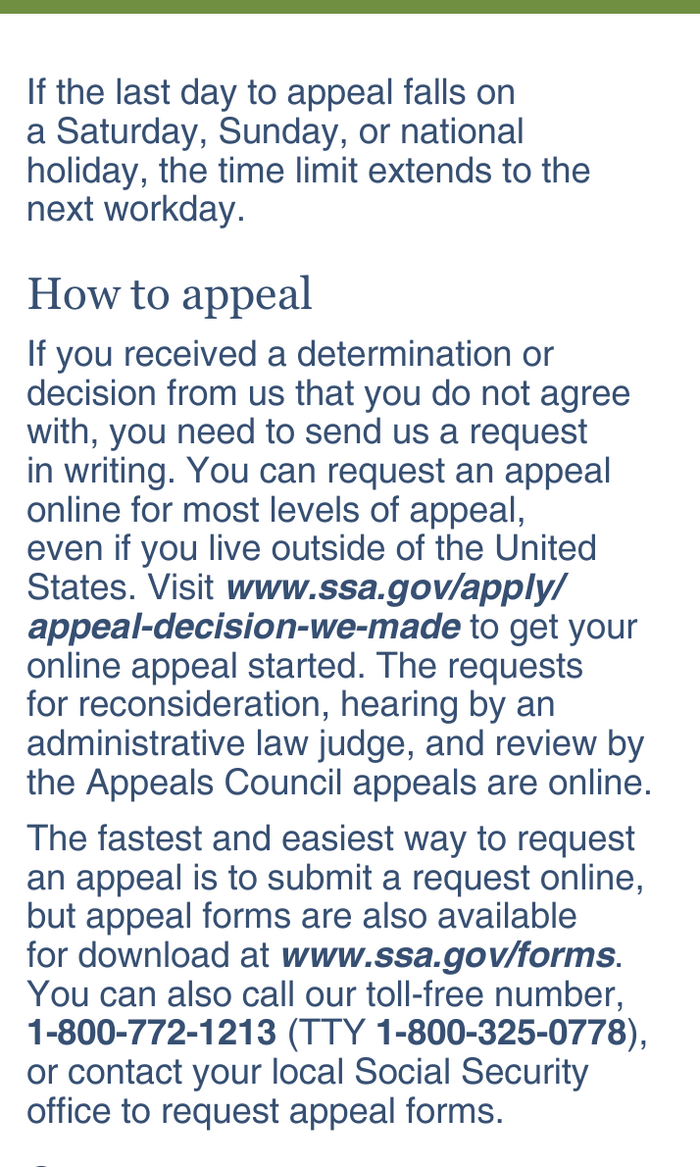
The letter says the decision may be appealed within thirty days.
There is an address. There is a form number. There is a sentence explaining that a person may submit evidence. On paper, a route exists.
But the person does not have the record the agency used. The form asks for a reason the decision was wrong without explaining the decision's actual basis. The only printer nearby charges by the page. The deadline runs while the person is trying to restore a disconnected phone. The legal-aid intake line opens during a work shift. The person could send something today, but doing so without the missing record may lock an incomplete argument into the file.
The institution may later describe what happened in one sentence: the person did not appeal.
That sentence records an outcome. It does not yet explain it.
This is a composite scene, not evidence about a particular agency or claimant. It exposes the question at the center of this essay:
When law permits a person to act, what makes that opportunity real enough to use?
Salutogenic Legal Design calls this a provisional inquiry into supported ability to act. It asks whether a person or collective has a real opportunity to begin, respond, continue, comply, correct, seek help, contest, or invoke a remedy under the actual conditions of a legal encounter.
The inquiry does not ask whether the person is sufficiently organized, motivated, intelligent, calm, or resilient. It asks what action the institution makes possible, for whom, under what conditions, with what support, and with what consequences for acting, waiting, refusing, or making a mistake.
Permission is only the first fact
Legal systems often describe participation through verbs: apply, answer, appear, object, request, disclose, correct, appeal.
A verb can make an institutional pathway sound self-executing. If a form exists, a person can apply. If a hearing is scheduled, a person can be heard. If an appeal is authorized, a person can appeal. If an accommodation may be requested, a person can request it.
Each statement may be formally true while remaining practically incomplete.
To act, someone may need to know that the route exists, understand what it is for, decide whether it is safe or worthwhile, obtain the necessary records, communicate in an accepted form, meet the timing rules, manage competing demands, receive assistance, recover from error, and bear the risk that the institution will respond adversely.
Some of those conditions belong to institutional intelligibility, the subject of Essay 3. Some concern resource obligation, the subject of Essay 4. Supported action is narrower and downstream: given the conditions and resources that exist, is there a practicable opportunity to take the relevant step?
That distinction matters. An institution may provide excellent instructions yet withhold the evidence needed to respond. It may supply a device yet offer no private place to use it. It may fund a navigator who cannot give legal advice when legal judgment is the central need. It may make a correction procedure easy to start but impossible to finish before harm occurs.
Supported action therefore cannot be inferred from a readable notice, an active hyperlink, an available help line, or a completed accessibility checklist.
Action is not one event
Institutional records often compress action into a binary: filed or not filed; appeared or failed to appear; completed or incomplete; accepted or denied.
The real sequence is longer. A person may have to:
recognize that action is possible or required;
identify the correct action and the actor authorized to receive it;
determine what information, evidence, money, assistance, or consent it requires;
begin within the available time;
continue through interruptions, requests, and institutional delays;
confirm that the institution received and attributed the action correctly;
correct an error or supply something missing;
understand the response; and
invoke review or remedy when the process fails.
A system can support one stage and defeat another. An online application may be easy to begin but impossible to save. A court may accept a filing but provide no reliable confirmation. A hearing may permit a person to speak while the governing procedure makes the relevant objection unknowable. An office may invite correction after an error but allow the original consequence to continue during review.
So the question is not merely, “Could the person do something?” It is, “Could the person take the action that mattered, in a form and time the institution would recognize, and carry it far enough to have the legal effect the route promises?”
A meaningful opportunity is context-specific
American due-process doctrine supplies an important but bounded legal reference point. The Supreme Court has repeatedly described due process as requiring an opportunity to be heard “at a meaningful time and in a meaningful manner.” In Goldberg v. Kelly, the Court considered the procedures required before termination of welfare benefits. In Mathews v. Eldridge, it applied a different procedural analysis to disability-benefit termination, balancing the private interest, risk of erroneous deprivation and value of additional safeguards, and government interests.
Those cases do not establish a universal right to every support that could make legal action easier. Nor do they convert “supported ability to act” into a constitutional standard. The procedure due depends on the protected interest, governing authority, institutional setting, risk, timing, and other context-specific considerations.
The doctrinal point is more disciplined: formal notice plus a theoretical route does not always resolve whether an opportunity is legally meaningful.
Other bodies of law may impose more specific duties. Title II of the Americans with Disabilities Act and its regulations can require covered public entities to make reasonable modifications and ensure effective communication, subject to the statute and regulations' terms and limitations. Statutes, court rules, program rules, constitutional provisions, and state or local law may create rights to counsel, interpretation, accommodation, review, timing protections, fee waivers, or other support in particular encounters.
Every such entitlement must be identified through current, jurisdiction-specific authority. SLD cannot manufacture a legal duty by calling a resource helpful. It can, however, reveal where formal permission, legal entitlement, practical support, and actual experience diverge—and direct the legal research to the right place.
Capacity is not a personal possession
It is easy to treat capacity as something located inside a person.
Did they understand? Did they comply? Did they advocate for themselves? Did they make a good decision? Did they ask for help?
Those questions can conceal the relational and institutional production of action. A person's ability to respond can change when the institution changes the language, timing, evidence access, communication channel, staffing, representation, physical setting, or consequence of error. The same person can appear “capable” in one encounter and “incapable” in another because the demands, supports, power, and stakes are different.
This does not mean individual variation is imaginary. Disability, age, language, literacy, prior experience, health, fatigue, trauma, caregiving, economic position, and many other conditions can shape an encounter. But SLD's purpose is not to infer cognition, diagnosis, motivation, or nervous-system state from behavior. A missed deadline does not reveal why it was missed. Silence does not prove lack of understanding. Refusal does not prove incapacity.
Supported ability to act is therefore relational and encounter-specific. It concerns the fit among the action demanded or permitted, the conditions surrounding it, the resources available, the distribution of power, and the person's or collective's own purposes.
That last element matters. The goal is not to maximize institutional completion.
Nonaction can be reasoned action
People do not always use a legal route because they cannot find it or complete it. They may decide the route is too dangerous, costly, exposing, futile, or inconsistent with their priorities.
A tenant may avoid a complaint that could provoke retaliation. A worker may decline an accommodation process that requires repeated disclosure to a supervisor. A survivor may not use a reporting system controlled by the institution implicated in the harm. A family may reject a service that increases surveillance. A community may refuse to participate in a consultation whose decisions have already been made.
Calling every non-use a “barrier” can erase judgment, distrust, resistance, and refusal.
An encounter record must distinguish at least four possibilities:
the route was not reasonably knowable;
the person wanted to act but lacked a necessary condition or support;
the person made a constrained choice among unacceptable options; or
the person chose not to act for reasons that should not be pathologized.
These possibilities may overlap. The record may not support a confident conclusion. That uncertainty should remain visible.
An institution's completion rate cannot tell us by itself whether people had supported ability to act. A high completion rate may reflect excellent support, low stakes, coercion, intensive unpaid assistance, or the exclusion of people who never entered the denominator. A low rate may reflect bad design, scarce resources, legal complexity, distrust, a defective remedy, or a rational judgment that the route will not help.
Help is not interchangeable
When action is difficult, institutions often reach for generic help: clearer instructions, a chatbot, a navigator, a video, an FAQ, a reminder.
Each may be useful. None is a substitute for identifying what kind of support the action actually requires.
Legal information explains law or process. Legal advice applies law to a person's circumstances. Representation changes who can speak, investigate, negotiate, preserve issues, and bear procedural responsibility. Interpretation supports communication across languages but does not supply legal analysis. An accommodation may change the channel or timing without supplying evidence. Material support may provide transportation, care, connectivity, fees, or time. A correction mechanism may repair institutional error. A stay, continuance, or interim benefit may prevent the opportunity from becoming useless while review occurs.
These supports have different functions, authorities, risks, and limits.
A navigator cannot cure a rule that requires legal judgment beyond the navigator's role. A chatbot should not be used to conceal uncertainty or create false confidence about deadlines and remedies. A reminder cannot replace time. Plain language cannot replace access to the record. A portal cannot replace counsel where counsel is legally required or practically indispensable. Better instructions cannot cure an unlawful demand.
The supported-action inquiry should therefore ask:
What exact action matters?
What legal effect must the action produce?
Which stage is failing: initiation, continuation, recognition, correction, contest, or remedy?
What kind of support would address that failure?
Who has authority and obligation to provide it?
What risks or dependencies would the support create?
Would changing the law, staffing, timing, evidentiary rule, or demand be more appropriate than adding assistance?
Correction and recovery are part of access
Most systems are designed around a clean first attempt. People and institutions do not operate that way.
Files are corrupted. Notices arrive late. Names are mismatched. Forms contain wrong data. Interpreters are unavailable. Portals fail. Staff give conflicting instructions. A child becomes ill. A bus does not arrive. A person misunderstands a question. The institution loses a document.
If one error permanently destroys the route, the institution has made perfection a hidden condition of participation.
Supported action includes the ability to discover what happened, correct the record, obtain human review, preserve the underlying claim, and recover before the consequence becomes irreversible. This does not mean every deadline must be open-ended or every error excused. It means that timing, notice, fault, stakes, institutional contribution, and available cure should be part of the encounter analysis.
The difference between a nominal and usable remedy often appears here. A person may technically appeal a termination after losing housing, medication, wages, custody time, or immigration stability. Later victory may matter enormously and still fail to restore what was lost while the process ran.
The question is not only whether review exists. It is whether the route can protect the interest at the time protection matters.
The supported-action record
Consider a requirement to answer an adverse decision.
The encounter record should not begin with a judgment about the person's capability. It should identify:
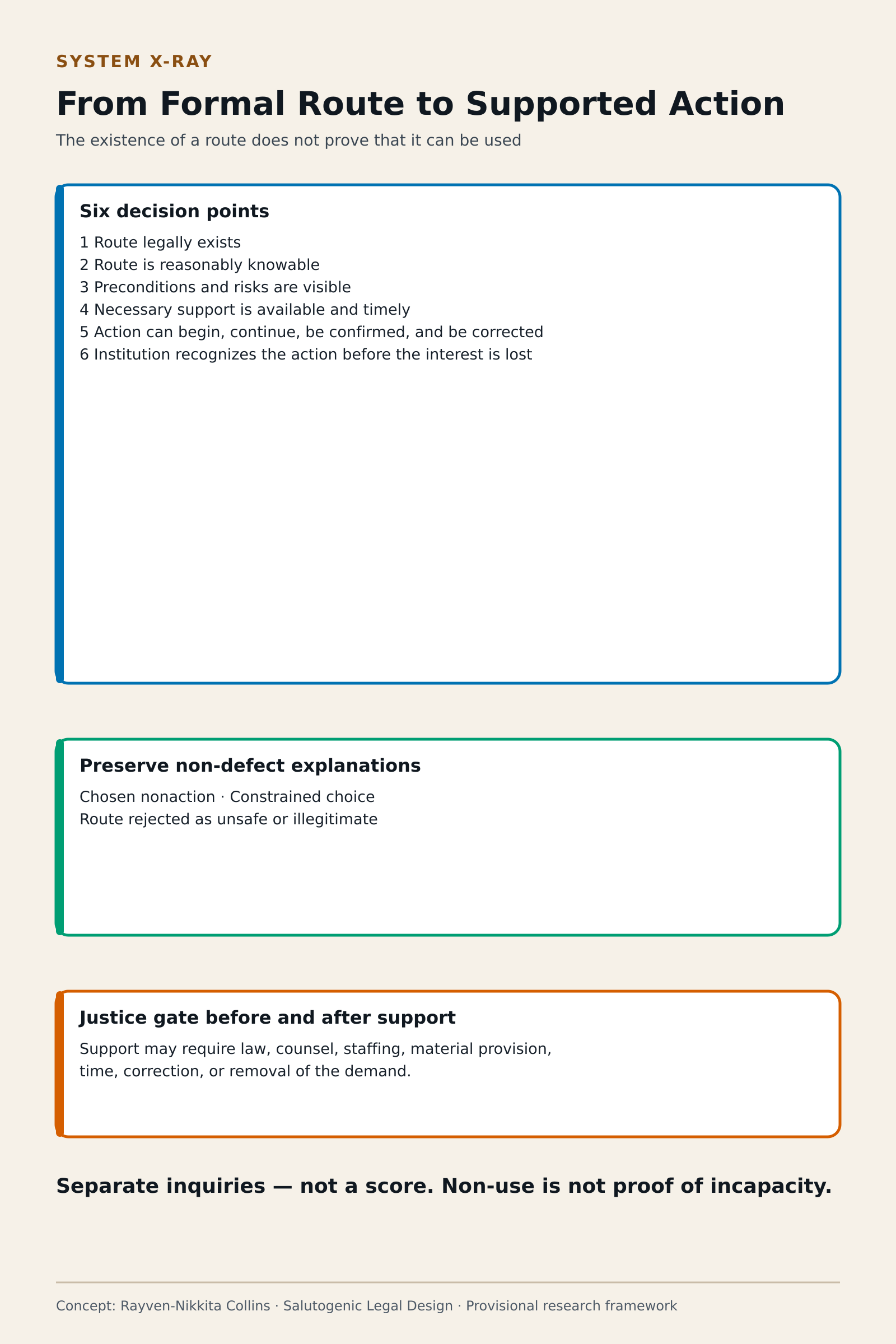
Relevant action: what must be initiated, submitted, said, preserved, corrected, or contested?
Legal effect: what happens if the action is recognized, and what happens if it is not?
Authority and timing: who created the route, who controls it, and when does it cease to be useful?
Preconditions: what notice, understanding, evidence, money, technology, assistance, safety, privacy, and time are necessary?
Actual support: which resources exist, who provides them, and whether they are adequate, accessible, coordinated, and timely?
Action sequence: where can a person begin, continue, confirm, correct, or recover?
Institutional recognition: how does the institution acknowledge receipt, attribute the action, and explain the next step?
Risk: what exposure, retaliation, surveillance, waiver, cost, or adverse inference may follow?
Alternatives: would counsel, staffing, direct material provision, a stay, simplified evidence, a different channel, legal reform, or removal of the demand be more appropriate?
Participant account: did the person or collective want to act, what did they understand the options to be, and what do they identify as consequential?
These are research and design questions, not a score. They must be answered with multiple forms of evidence: governing law, actual workflow, institutional records, observation, usability testing where ethically appropriate, and the accounts of affected people. Disagreement must be preserved rather than averaged away.
Support can become control
An intervention that helps people act can also increase institutional power.
Automated reminders can become monitoring. Identity verification can exclude people or expose sensitive data. A navigator can become an enforcement intermediary. A digital assistant can steer people toward completion without communicating alternatives, uncertainty, or the right to refuse. A supported-decision process can become substituted decision-making if the supporter controls the information or outcome.
This is why SLD's justice gate operates before and after design.
Before intervention, ask whether the demand and legal purpose are lawful, necessary, and legitimate; how burdens and benefits are distributed; whether refusal is possible; and whether the appropriate response is redesign, material provision, representation, policy change, legal change, or abolition of the demand.
After intervention, ask who gains information or control, whose labor expands, whether surveillance or dependency increases, whether the intervention substitutes for a legal entitlement, and whether the person's ability to contest the institution becomes stronger or weaker.
Supported action is not the same as assisted compliance.
What would count as evidence?
SLD has not validated “supported ability to act” as a measurement construct. It should not be presented as a diagnostic tool, certification, or single number.
Early research would need to examine whether the inquiry can be defined and observed consistently across legal encounters without collapsing distinct causes. It would need to distinguish institutional support from personal experience, formal permission from actual uptake, and constrained nonaction from inability. It would need affected participants to help govern the questions, interpretations, risks, and publication—not merely react to a finished instrument.
Possible evidence might include where people leave a process, how long steps take, whether records are available, whether assistance changes error or completion, how often correction succeeds, what interim harms occur, and how participants describe their choices. None of those indicators alone establishes justice. Completion can increase while coercion deepens. Satisfaction can coexist with an unlawful result. A lawful process can remain inaccessible. A usable process can produce substantively unjust outcomes.
The outcome families must remain separate: process performance, participant experience, supported participation, legal outcomes, and justice or distributional outcomes.
A right becomes real in conditions
Law does not become usable because a sentence says “you may.”
It becomes usable through time, information, evidence, money, access, assistance, safety, recognition, correction, and remedy. It also becomes usable through legal rules that constrain the institution, allocate responsibility, preserve interests while review occurs, and sometimes require a person not to stand alone.
The task is not to make every person better at navigating whatever system already exists.
The task is to determine what the institution demands, what action the law promises or requires, what conditions make that action real, who is responsible for those conditions, and whether the route deserves to exist in its present form.
A person may have a right in doctrine and no practical way to invoke it. They may have assistance and no safe reason to trust it. They may complete every step and still receive no meaningful response.
That last distinction leads to the final essay in this opening season: participation is not established merely because a person was able to act. We must still ask whether the institution could be contested, whether the person was recognized, and whether anything they did could alter what happened next.
A Hawaiʻi observation

Source Desk
Goldberg v. Kelly, 397 U.S. 254 (1970) — procedural protections before termination of covered public benefits and the meaningful-time/meaningful-manner formulation.
Mathews v. Eldridge, 424 U.S. 319 (1976) — context-specific procedural due-process analysis balancing private interest, risk and value of safeguards, and governmental interests.
U.S. Constitution Annotated: Opportunity for Meaningful Hearing — congressional legal summary of the opportunity-to-be-heard doctrine.
Americans with Disabilities Act, Title II and 28 C.F.R. part 35 — governing statutory and regulatory sources for covered state and local public entities.
Adjacent research and practice authorities
Pamela Herd and Donald P. Moynihan, Administrative Burden: Policymaking by Other Means — book-length treatment of learning, compliance, and psychological costs and their policy production.
Donald P. Moynihan, Pamela Herd & Hope Harvey, “Administrative Burden: Learning, Psychological, and Compliance Costs in Citizen-State Interactions” — originating analytic framework used adjacent to, not absorbed by, SLD.
National Center for State Courts, Remote Proceedings Toolkit — court-oriented implementation resources illustrating how technology, access, procedure, privacy, and support interact.
American Bar Association, Civil Right to Counsel Resources — jurisdictionally varied civil-counsel landscape and access-to-justice resources.
Further Reading & Learning
DOJ: State and Local Governments under Title II of the ADA — official overview of public-entity obligations.
DOJ: Guidance on Web Accessibility and the ADA — official guidance on digital access; not a substitute for encounter-specific legal analysis.
Legal Services Corporation, The Justice Gap — evidence on unmet civil legal needs among low-income Americans.
National Center for Access to Justice, Justice Index — comparative state-policy indicators on access to justice.
Sources are reproduced rather than linked. Claims that failed are printed with the verdict on them.
Subscribe — complete in the inbox.